© All rights reserved
History of Fabric Printing
Printing on fabric with wooden blocks was known in ancient times in Asia, probably originating in China, as a method for printing on cloth and later on paper. The oldest examples come to us from China before 220 and from Egypt in the 4th century.
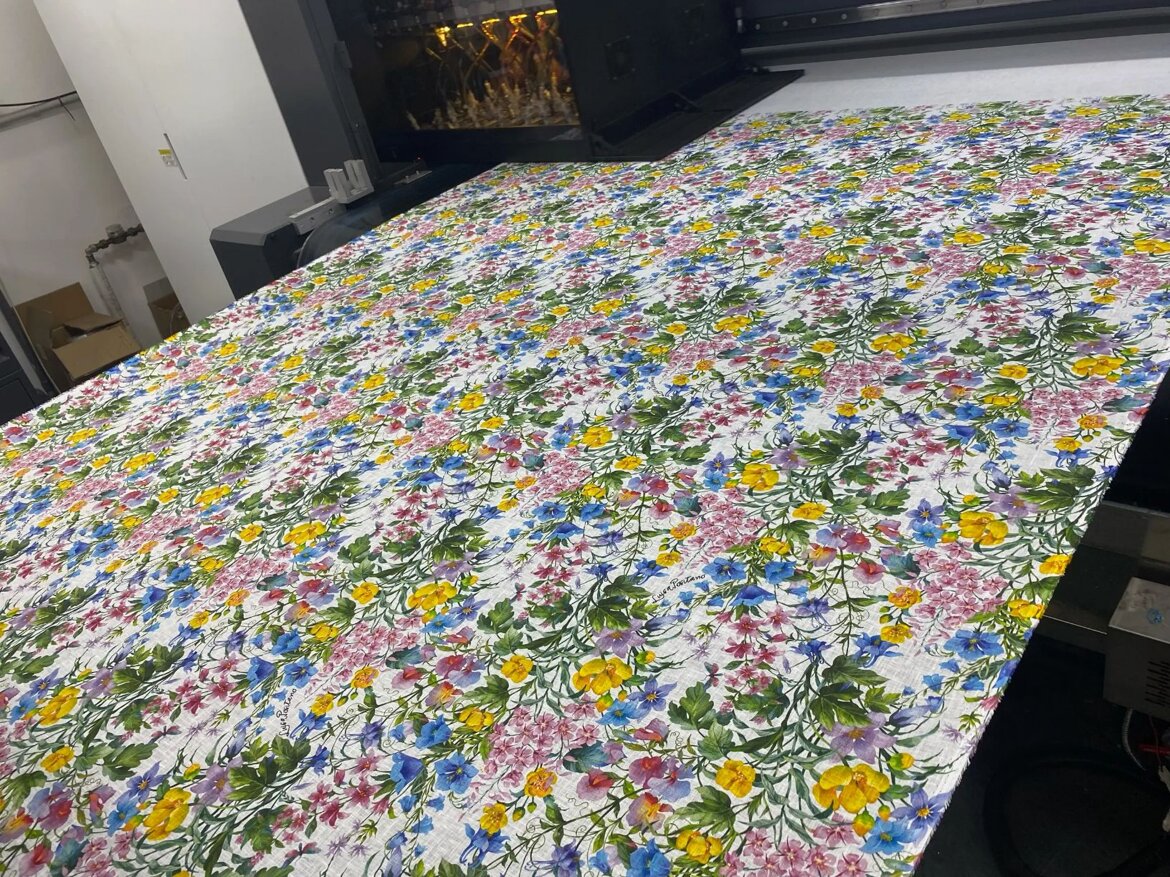
By fabric printing is meant the art of decorating a fabric, whatever its nature or quality, with designs in one or more colors that can be applied to it by various means.
The origins of this art, which was almost certainly preceded by that of dyeing, go back to the most remote antiquity: most likely, the cradle of all the methods applied in fabric printing was India, although there are authors who attribute its invention to the Chinese. In any case, it is certain that Pliny reports that the Egyptians were very skilled in the manufacture of dyed fabrics decorated with various and variously colored designs, by applying mordants and then dyeing with natural substances, probably madder and indigo. Decorated Indian fabrics, whose designs were executed by hand, were known in Europe under the French name indiennes very early, certainly long before the first attempts were made to produce something similar or to imitate them in any way. It would be difficult to establish at what precise time and where in Europe the very first examples of this art were seen: most likely they began simultaneously in several countries, where they had the character more of paintings on fabric than of true printing, so much so that the name toiles peintes, used for a long time to indicate this production, preceded by far that of tissus imprimés. From samples existing in the Kensington Museum, it appears that examples of printed cloth were already found in Sicily in the 13th century: a sample of cotton fabric, mentioned in A. Sansone's treatise, Printing of Cotton Fabrics (Manchester 1887), a fabric offered by Sir J. Lee to the author, would prove that, in Italy, the art of printing fabrics, using brushes and wooden blocks, was certainly known in the 16th century; on the other hand, in England, the East India Company was granted licenses in 1619, 1634, and 1675 for the production of printed indiennes: in 1689 a factory for these fabrics was established near Neuchâtel; in 1746 the Koechlin brothers founded their printed fabric factory in Mulhouse, which was later to achieve worldwide renown; in 1738 the first factory arose in Scotland and in 1763 the first in Manchester.
However, all this production was done by hand, either roughly as a painting, or in a more industrial form, with wooden blocks applied by hand to the fabric after being passed over frames soaked in color. Naturally, the production obtained with these means could only be very limited: it was only after the introduction of mechanical means that one could speak of a real fabric printing industry. The stages that the adoption of mechanical means went through can be briefly indicated as follows: around 1790, J. Leitenberger created the first block printing machine; in 1830 Perrot of Rouen followed with his machine, which retained the name "perrotine", which, taken up by Hummel of Berlin, was greatly improved by him, so that there were models with reciprocating movement and models with rotary movement, which are still used today in some branches of production. Meanwhile, the idea found and patented by the Scotsman Bell of a copper cylinder machine (in a patent he applied for in 1783, a model capable of printing up to six colors is described) spread everywhere and soon numerous examples of machines of this type, subsequently improved, were installed in England, Germany, Switzerland, France (we recall the pioneers Livesey, Hargraves, Hall & Co. of Preston, Leitenberger of Reichstadt, the Herosé brothers of Aarau, Oberkampf of Jouy in France, the Wesserling Manufactory in Alsace).
The impetus given by the adoption of cylinder machines was so great and so widespread that, despite the fact that in some countries, such as England, a special law (enacted in 1720, repealed in 1774) forbade women to dress in printed cloths and production was hit with rather heavy taxes, by 1830 English production had risen to 8 million pieces of 25 yards each annually and by 1840 to as many as 16 million.
Not long after, this industry found, in the discovery of artificial dyes, another formidable boost that only at the beginning of the 20th century was to stop, having reached in all industrial countries an extraordinary extent, of which the number of printing machines can give an idea: in the Manchester industrial district alone, by around 1900, there were over 500, many of which printed 10-12 and up to 14 colors.
In general, the main processes necessary for printing a fabric can be summarized in the following two: actual printing, that is, application of the color to the fabric; fixing the color (steaming) and complementary fixing. Preparatory operations are bleaching, mercerization, and shearing; finishing operations are washing, drying, and finishing.
© All rights reserved